
September 28th, 2026
The Authority Cycle:
How a 28-Day Publishing Cadence Builds AI Visibility
Most organizations still treat news releases like fire alarms—used only when something big happens.
A product launch. A funding round. A partnership. An award.
The release goes out, gets picked up, and then the newsroom goes quiet until the next “real” announcement.
That approach made sense when the primary audience for a news release was a group of journalists scanning a wire feed.
Today, the audience is much larger.
Search engines, AI assistants, journalists, customers, investors, partners, and employees are all looking for current, trustworthy information about your organization.
Increasingly, AI platforms are also deciding which sources to cite when someone asks about your company, your products, or your industry.
AI visibility is not built through occasional spikes. It is built through consistent presence.
The Problem with Event-Driven Publishing
When your only public signal is a news release every few months, you create long gaps between authoritative updates.
During those gaps, competitors publish. Analysts publish. Media outlets publish. Trade associations publish.
Newer sources begin filling the information space around the topics your organization wants to own.
If the most recent page on your newsroom is six months old, search engines and AI platforms have fewer current signals showing that your organization is active, relevant, and still the best source of information.
The companies appearing consistently in ChatGPT, Gemini, Perplexity, Google AI Overviews, and traditional search results are not always the companies making the biggest announcements.
They are often the companies maintaining the steadiest publishing rhythm.
Introducing the Authority Cycle
At Reportable, we encourage organizations to stop thinking about news releases as isolated events.
Instead, think in terms of The Authority Cycle: a repeatable publishing rhythm designed to strengthen digital authority over time.
The concept is simple:
Every 28 days, publish something useful that reinforces your organization’s activity, expertise, and relevance.
The goal is not to publish for the sake of publishing.
The goal is to avoid disappearing.
A predictable cadence gives search engines, AI platforms, journalists, and other audiences a continually refreshed source of information about your organization.
Why 28 Days?
The number is not magic.
It is practical.
Search engines and AI platforms use different systems to discover, evaluate, and surface information. No single publishing interval guarantees visibility or citation.
But recent, well-structured, consistently updated content gives those systems more opportunities to discover and understand your organization.
A 28-day rhythm creates enough frequency to maintain momentum without forcing teams to publish every week.
It also creates discipline.
Instead of asking:
Do we have news this month?
The better question becomes:
What is the most valuable thing we can publish during this cycle?
That shift turns publishing from a reactive task into an ongoing authority-building strategy.
What Can You Publish Every 28 Days?
One of the biggest objections to a regular publishing cadence is simple:
We do not have major news every month.
You do not need it.
A healthy Authority Cycle should include a mix of company news, expertise, proof points, and market perspective.
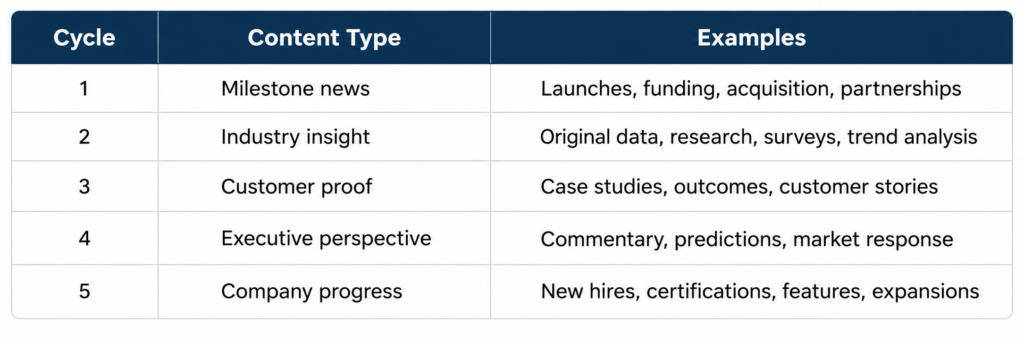
Then repeat the rotation.
The objective is not to manufacture news.
It is to consistently document the expertise, activity, and progress already happening inside the organization.
Five Steps for Building Your Authority Cycle
1. Plan in 28-Day Cycles, Not Calendar Months
A monthly editorial calendar sounds simple, but calendar months create drift.
Some months are longer. Deadlines move. “Once a month” becomes “sometime this month,” and eventually the gap stretches to six or eight weeks.
A 28-day cycle creates a fixed rhythm.
Over the course of a year, that gives your organization approximately 13 publishing opportunities, not 12.
Set the cycle dates in advance and treat each one as a committed publishing window.
2. Rotate Content Types
Do not begin each cycle by asking what news you can invent.
Create a repeatable content rotation that pulls from different parts of the business.
For example:
- Major company news
- Original data or research
- Customer stories
- Executive commentary
- Product or company updates
A rotation makes the calendar easier to sustain and gives product, sales, marketing, communications, customer success, and leadership teams a clear way to contribute.
3. Keep an Evergreen Story Ready
Not every cycle will produce an obvious announcement.
That is why every editorial calendar needs at least one evergreen idea in reserve.
Strong fallback topics include:
- Commentary on an industry trend
- A customer insight
- Original data
- A survey finding
- An executive point of view
- A frequently asked customer question
An evergreen story prevents one slow month from breaking the entire cadence.
4. Assign an Owner to Every Cycle
Do not assign ownership only when a story appears.
Assign an owner to each cycle date.
That person is responsible for identifying the topic, gathering the information, and moving the release forward.
Ownership tied to a deadline creates accountability.
Ownership tied to “whenever we have news” creates delay.
5. Measure Visibility Beyond Pickup
Traditional PR metrics still matter, but they do not tell the whole story.
In addition to pickup, impressions, and traffic, evaluate whether each release is:
- Indexed quickly
- Appearing in AI-generated answers
- Driving visitors to your owned content
- Generating engagement over time
- Reinforcing the topics your organization wants to own
- Shortening the gap between publication and discovery
The goal is to create a feedback loop.
Which topics were cited most quickly? Which structures performed best? Which releases continued generating traffic after the initial announcement?
Use each cycle to improve the next one.
Authority Compounds
One news release creates a moment of awareness.
A consistent publishing cadence creates a growing body of authority.
Each release gives your organization:
- Another indexed page
- Another crawl opportunity
- Another source AI platforms can reference
- Another opportunity to reinforce your expertise
- Another current page connected to the topics you want to own
Over time, those signals accumulate.
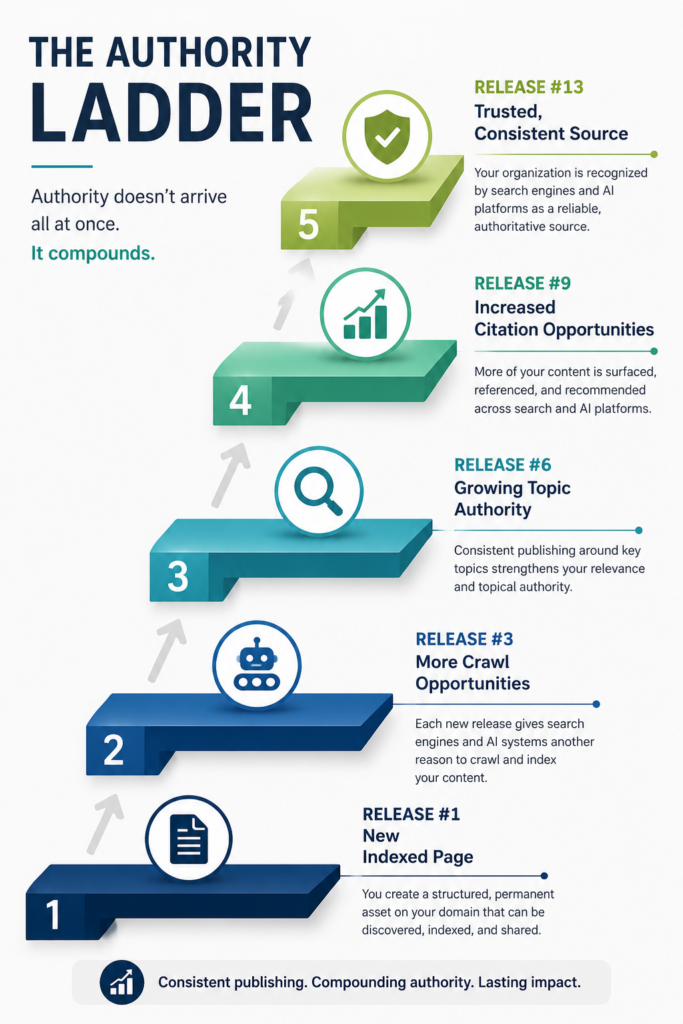
The Authority Ladder illustrates that progression:
- Release #1: A new indexed page
- Release #3: More crawl opportunities
- Release #6: Growing topic authority
- Release #9: Increased citation opportunities
- Release #13: A trusted, consistent source
Authority does not arrive all at once.
It compounds.
Authority Compounds
A 28-day cadence is not a promise that every release will be cited by an AI platform.
It is not a shortcut for weak content.
And it is not an excuse to publish low-value announcements simply to fill a calendar.
Cadence works best when each release is:
- Relevant
- Accurate
- Clearly structured
- Published on an authoritative destination
- Supported by useful context, sources, and assets
- Connected to the topics the organization wants to be known for
Frequency creates opportunity.
Quality determines whether that opportunity becomes authority.
The Takeaway
The role of the news release is changing.
It is no longer just a record of what happened yesterday.
It is part of an organization’s ongoing source of truth for search engines, AI platforms, journalists, customers, investors, and partners.
The Authority Cycle gives organizations a practical way to build that source of truth over time.
Not by publishing constantly.
Not by manufacturing news.
By consistently showing that the organization is active, credible, and worth citing.
The companies most visible in AI-generated answers over the next several years will not necessarily be the companies with the biggest announcements.
They will be the companies that publish valuable information—and never stay silent for too long.
When was your last news release?
If you have to think about the answer, there’s a good chance your audience—and the AI platforms helping people find information—have already moved on.
That’s exactly what the Authority Cycle is designed to prevent.