
May 6th, 2026
The Strategy Newswires Tried to Kill
(And Why It Matters More Today)
Karen Reynolds, Head of Business Development
I built my career working at the major newswires.
The pricing model was simple: charge by the word. Roughly $1,000 for the first 400 words plus about $150 for every additional 100 words—or even a fraction.
That structure shaped behavior in a major way.
Companies became disciplined. Press releases were trimmed, debated, and optimized. Every sentence had a cost.
Except for one category.
Earnings releases.
Four times a year, every public company has to disclose detailed financials—tables, summaries, and full transparency. These releases regularly ran over 4,000 words.
And they were expensive.
So naturally, companies became excited about a workaround following a corporate disclosure blessing by the SEC.
Reg FD Disclosure via “Recognized” Channels
The SEC guidance, issued in 2008, made things simple: Publish your news without a newswire on a recognized channel like your website or via social media.
This dramatically reduced costs.
Instead of paying for thousands of words on the wire, companies were:
- Controlling the full experience on their own site
- Publishing richer, more flexible content
- Avoiding turning disclosure into a line-item expense machine
- Taking advantage of the power of social media
It was efficient. Logical. And increasingly appealing.
Problem 1: Incentives
Newswires hated it.
Not quietly—structurally.
Their business depended on word count. This new model directly threatened the old model.
Early adopters, many major companies like Qualcomm and Biogen, moved forward. At first cautiously. Then more boldly. It was seemingly risky. But it worked. Because the core idea was sound: The primary version of your announcement should live in full on a page you own—not rented space priced by the word surrounded by distracting ads and competing content
Pushback from newswires came quickly. I was in a role where I had to have that conversation with clients—regularly.
The sales team countered with several angles, notably:
– It wasn’t best practice;
– it risked “unfair disclosure”;
– their website might not handle the traffic;
– investors expected the full release on the wire.
We assumed the media wouldn’t prefer this either.
The list of reasons was long.
But looking back, most of them weren’t about the client.
They were about protecting the model.
Problem 2: Going Beyond Your Core Audience
Audiences that already followed your company and developments love it.
Prospective audiences might miss out. Email, RSS feeds and social media do a great job, but gaps remained.
Enter: Lede and Link
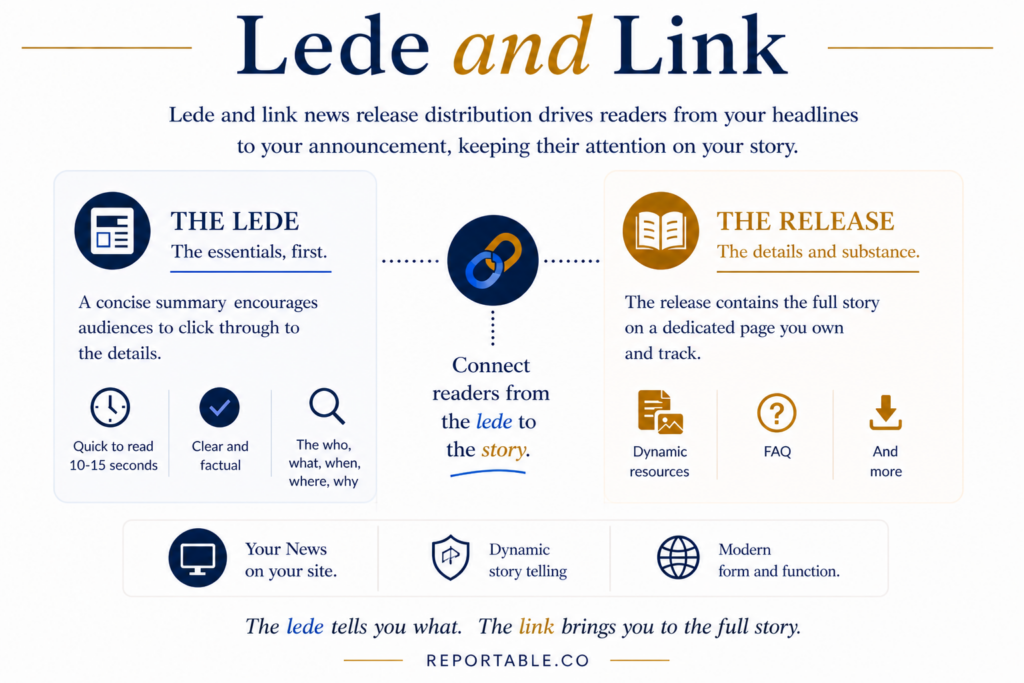
Taking a page out of the marketers’ “inbound marketing” playbook, lede and link distribution is a model that brings readers to a page you own and control, free from distractions, while still ensuring current and prospective followers don’t miss a thing.
How it works: Send out a teaser that entices readers back to the primary and full version of your release. This can include a social media post of a headline with a link back to your newsroom. Or it can be an email to your subscribers. And because not all companies have the following of a Qualcomm or Biogen, it can be a summary news release (headline, first paragraph, takeaways, and/or boilerplate) that gets sent via the traditional wire channels, which invites readers to read the full content on your property.
Lede and Link isn’t just about cost savings. It’s about control and clarity.
When you host the full release yourself, you can:
– Create a clean, structured experience (closer to a press kit or microsite)
– Ensure there’s a single canonical URL for your audience
– Add context, visuals, and navigation that a wire simply can’t support
– Update or extend content without republishing an entirely new release
– Actually measure engagement and behavior
In other words, you turn a static disclosure into a living asset.
The Bigger Lesson
At the time, I argued against Lede and Link.
Because that was the job.
Today, I’d argue the opposite.
What looked like a workaround was actually a shift in thinking:
From distribution-first → to ownership-first
From paying for reach → to building a destination
And from optimizing for a pricing model → to optimizing for the audience
Final Thought
Sometimes the most interesting strategies aren’t the ones everyone adopts.
They’re the ones that get quietly discouraged—because they change who holds the leverage.
Lede and Link was one of those.
And it might be more relevant now than it was back then.
Resource: https://ledeandlink.com/